 blog
blog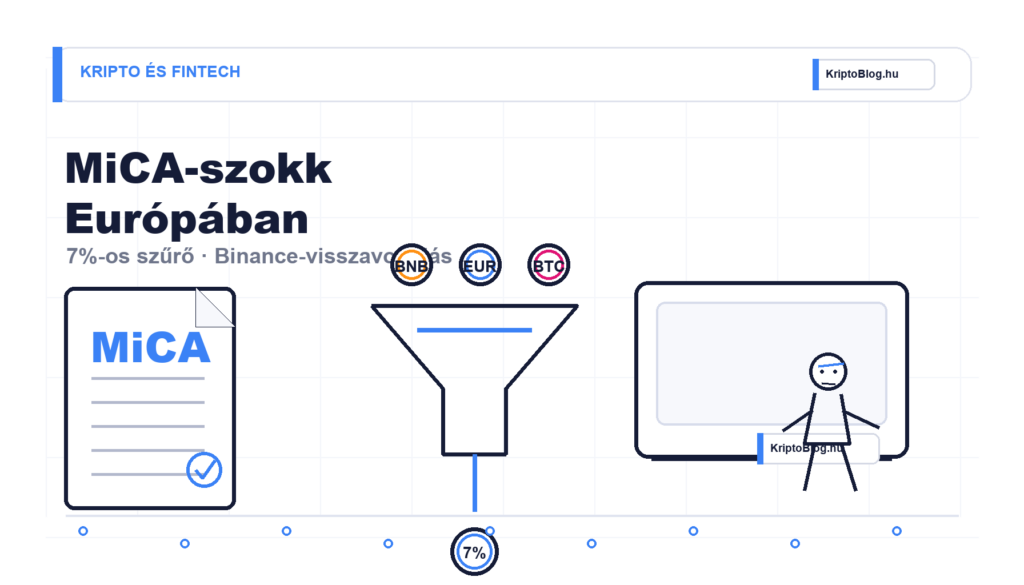
For years, crypto markets were comfortable in grey zones: fast growth, uneven rules and plenty of cross-border loopholes. The July 1 MiCA deadline has closed that chapter in Europe. From here, the question is no longer who can grow the loudest, but who can operate in the EU with authorisation, transparent controls and responsible customer communication.
This shift became most visible around Binance. The company withdrew its MiCA application in Greece and said it would pursue authorisation in another EU member state. At the same time, crypto.news reported that Coinbase and OKX quickly started courting European users who now need to reconsider where they trade.
What happened on July 1?
MiCA is not a recommendation. It is the EU’s unified rulebook for crypto-asset markets. Its aim is to make providers more transparent, give consumers better risk information and reduce reliance on informal promises. ESMA’s MiCA page states that the interim register includes authorised crypto-asset service providers as well as non-compliant entities; the register is updated weekly, so the exact numbers can move over time.
According to data cited by CoinGabbar, out of more than 3,000 crypto firms operating in Europe, roughly 210 had full MiCA authorisation around the July 1 deadline. That is about 7%. Treat this as a market signal rather than a fixed final count: the regulatory filter is narrow, and many providers still do not have a clear, verifiable European compliance path.
Why does this hurt major exchanges?
MiCA is not a simple sign-off exercise. It involves authorisation, capital and client-asset safeguards, governance expectations, risk management, record keeping and cooperation with supervisors. Crypto’s old “move fast and break things” logic does not work the same way here: in the European financial-supervision environment, speed is not enough without provable control.
Binance’s official update says user assets remain accessible and that the company will communicate directly with affected EU users. That distinction matters. This is not a story about funds disappearing overnight; it is about service scope, new-user onboarding and long-term European operations being limited to authorised channels.
Coinbase, OKX and the marketing value of compliance
Competitors noticed the vacuum quickly. According to crypto.news, Coinbase and OKX used campaigns, transfer bonuses and their regulated status to address users unsettled by Binance’s European position. This is a classic trust moment: when users reconsider a platform, legal stability suddenly matters alongside fees and bonuses.
A cool head still matters. A bonus can be a useful entry incentive, but it does not replace checking fees, supported assets, withdrawal conditions, customer support and local tax consequences. In the MiCA era, “where do I get a bigger promo?” has to be paired with “where do I understand exactly what service I receive and under what legal framework?”
What does it mean for European users?
In the short term: more noise, more notifications and more decisions. EU users who rely on Binance should follow official account-specific messages and avoid phone calls or social-media “support” offers. Regulatory transitions are fertile ground for phishing attempts, so passwords, 2FA codes and private keys should never be shared.
In the medium term, the market may become cleaner but less wild. Some smaller providers will likely struggle to finance the full compliance apparatus, so choice may narrow. In exchange, the remaining players will need stronger controls, better documentation and more predictable customer handling. That is less exciting, but it is the base layer of a more mature market.
The real message of the 7% filter
The key point is not whether a given weekly register shows exactly 210 or 213 entities. The point is the ratio: in Europe, crypto operations are no longer just a technology and marketing question. They are also an authorisation and trust question. Those who understood this early now have an advantage. Those who moved late must quickly clarify what they can still offer in the EU.
Binance’s story is therefore not only a Binance story. It is a warning to every global crypto provider: in the EU, being large is not enough; operating under the rules matters. Users do not need to panic, but they do need to be more deliberate than in the looser market years.
KriptoBlog.hu view
This is not the end of crypto in Europe. It is the end of the wild-west phase. MiCA may also filter out viable innovators, so the cost of regulatory strictness should not be ignored. At the same time, mainstream adoption needs users to choose services based on verifiable rules rather than vague promises.
This is not investment or tax advice. Anyone considering a platform move should check the provider’s authorisations, fees, supported assets and the tax rules in their own country. The good decision now is not the fastest click, but the clearest information.
Sources
- ESMA – Markets in Crypto-Assets Regulation (MiCA): source
- Binance Blog – Important Update for Our European Users (2026-06-24): source
- crypto.news – Coinbase, OKX chase Binance users as MiCA deadline bites (2026-06-28): source
- CoinGabbar – Binance MiCA Withdrawal: Why Coinbase, Kraken, OKX Won EU Approval? (2026-06-26): source




Comments
Share your view: questions, corrections, and counterpoints are welcome. Comments are for constructive, useful discussion.