 blog
blog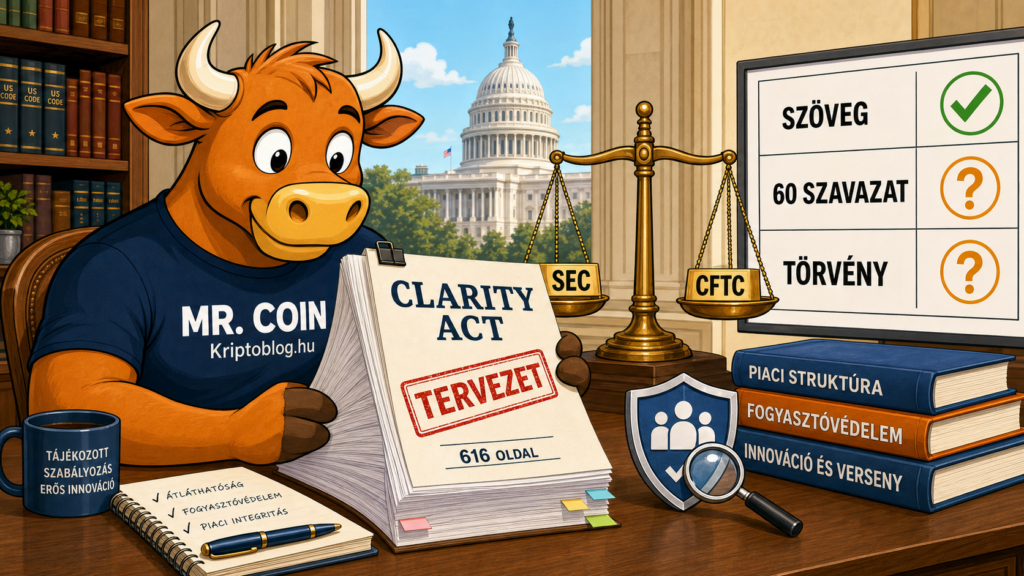
The new Senate text of the CLARITY Act is an important milestone for US crypto-market regulation, but it is not yet law and the political majority needed to pass it is not assured. The 616-page draft released on July 22 would draw a more detailed line between the SEC and the CFTC, while Democratic negotiators are still seeking stronger provisions in several key areas.
Verification date: July 25, 2026. This informational article does not constitute legal advice, tax advice, or investment advice.
What exactly was released?
According to Senator Cynthia Lummis's official release, a new Senate amendment to H.R. 3633 was published on July 22, 2026. The document combines work by the Senate Banking Committee and the Senate Agriculture Committee in a single proposal. The full text runs to 616 pages and is structured as an "amendment in the nature of a substitute," meaning a Senate version intended to replace the House bill text.
That is not the same as an enacted law. Congress.gov still lists H.R. 3633 at the "Passed House" stage. The House approved its version by 294 votes to 134 on July 17, 2025; the congressional tracker shows that the Senate process has not yet reached a final vote.
The Senate Banking Committee advanced its CLARITY text by 15 votes to 9 in May 2026. That was meaningful progress, but a committee vote does not replace approval by the full Senate. The July version matters because its sponsors intend it to serve as a shared basis for the next negotiating stage, while its language can still change.
What would the draft rearrange?
The official section-by-section summary says the proposal would more clearly divide the SEC's securities remit from the CFTC's digital-commodity remit. It would establish a disclosure regime for so-called ancillary assets and set conditions under which a blockchain-based asset may be treated as a digital commodity. Those provisions are designed to reduce uncertainty in current US legal interpretation.
The draft would give the CFTC direct oversight of digital-commodity spot markets. It would impose registration and operating requirements on intermediaries, set rules for segregating customer property, and require risk disclosures. Its purpose is therefore not limited to drawing a border between agencies; it would also create an operating framework.
The 616-page text reaches beyond that division of authority. It addresses illicit finance, aspects of decentralized finance, rewards related to stablecoins, protections for software developers, customer property, cooperation among authorities, and ethics rules for public officials. The legal effect of individual chapters can only be assessed against the final text.
Passage would not make every provision operational overnight. The official section-by-section document gives the SEC and CFTC a 360-day rulemaking deadline for several tasks, measured from enactment. Even after a successful congressional and presidential process, implementing rules, registries, and supervisory procedures would still be needed.
Why do supporters emphasize crime prevention?
The bill's sponsors highlight anti-money-laundering and anti-fraud provisions in a separate fact sheet. They say the draft would extend and clarify Bank Secrecy Act obligations, address crypto ATMs, allow certain suspicious transactions to be held temporarily, and assign new coordination work to FinCEN and cybercrime authorities.
Those points should be described as the sponsors' account of the proposal, not as an independent impact assessment. The legislative text does contain law-enforcement and financial-compliance sections, but their effectiveness would depend on the final wording, implementing rules, agency capacity, and judicial interpretation.
For investors, "stronger enforcement" is therefore not a single switch. The practical questions include which providers must register, how customer assets must be segregated, when a transaction may be held, and what remedy is available after an incorrect intervention. The final law and subsequent rules, rather than a political slogan, would answer those questions.
Why is a Senate majority still uncertain?
Seven Democratic senators involved in the negotiations said in a joint statement that the current text remains insufficient in several material areas. They highlighted ethics in public office, consumer protection, illicit finance, conflicts of interest, and market integrity. At the same time, they said they intended to continue bipartisan negotiations.
Senator Elizabeth Warren issued a sharper criticism, focusing in particular on ethics enforcement and possible loopholes. That is a political position and should not be repeated as an established legal fact, but it does show that Democratic support for the July 22 version is not unified.
On the other side, the Blockchain Association, Crypto Council for Innovation, and Digital Chamber jointly urged the Senate to bring the CLARITY Act to the floor. That is significant industry support, but it is not the same as the required Senate votes. Trade groups can press for floor consideration; lawmakers themselves form the congressional majority.
CoinDesk reported that moving forward is expected to require a 60-vote coalition, while the timing of floor consideration remains unclear. That makes the Democratic negotiators' objections central: revisions to a handful of provisions may be both a policy requirement and a procedural condition for the proposal to reach a final vote.
What changes in the market now?
Nothing changes immediately. Publishing the new text does not alter the rights or duties of exchanges, brokers, token issuers, or users from one day to the next. Existing rules and enforcement practice remain in place unless and until both chambers pass the same bill, the president signs it, and agencies issue any required implementing rules.
The document is still a valuable signal for companies. It shows the registration, customer-protection, asset-classification, and compliance expectations around which the next US framework may be built. A responsible business decision, however, cannot assume that the July language is final.
If the Senate passes legislation that differs from the House version, both chambers must agree on identical text. Presidential action could then be followed by the SEC, CFTC, and other agencies completing rulemaking required by the statute. From the market's perspective, several individually meaningful stages remain.
What should readers watch?
The next verifiable milestone will be a floor schedule and any amendment package. Key questions are whether lawmakers can assemble a coalition near 60 votes, how the ethics and consumer-protection chapters change, whether the SEC-CFTC allocation survives, and what deadlines implementing agencies ultimately receive.
The most accurate summary today is this: a more detailed and politically consequential Senate CLARITY draft now exists, backed by a committee vote and industry advocates, but it has not been approved by the full Senate. The text points toward a possible framework; a legal change would come only after further votes, identical congressional text, presidential action, and implementation.







Comments
Share your view: questions, corrections, and counterpoints are welcome. Comments are for constructive, useful discussion.