 blog
blog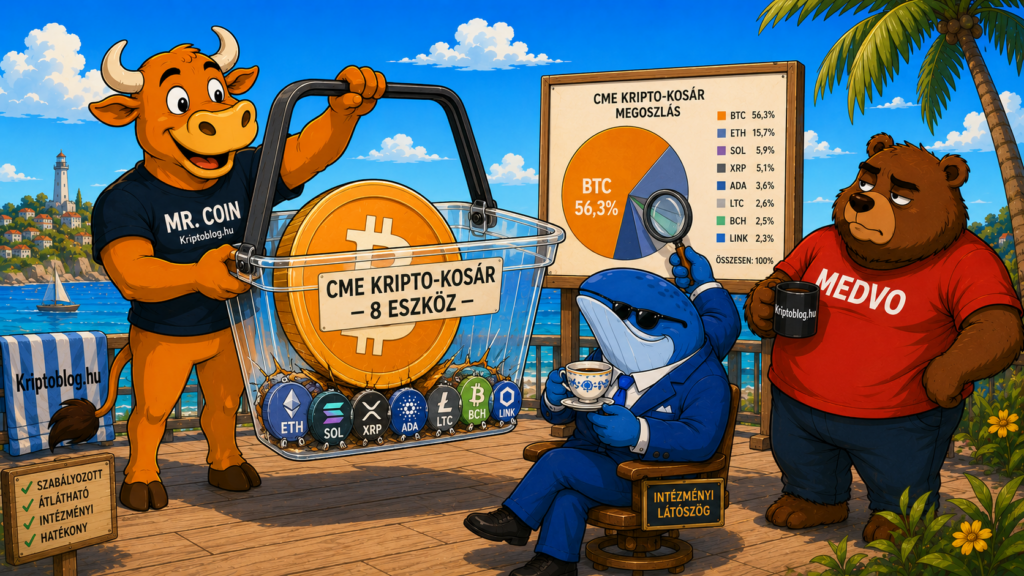
There hasn't been a week in a while where institutional infrastructure built out this aggressively while spot prices moved in the opposite direction. The launch of CME's new futures product bundling eight crypto assets into a single contract, Mastercard's stablecoin settlement announcement spanning eight blockchains, and Kalshi's applications for altcoin perpetual futures together sketch a deeper story. The price action, however, isn't reading that story — and that itself is instructive.
CME's big move: one contract, eight assets
A CME Group június 8-án indította el a Nasdaq CME Crypto Index Futures kontraktust, amely a Nasdaq CME Crypto Settlement Price Indexet követi — erről a Stocktitan és a The Coin Republic egyaránt beszámolt. Az index június 9-én nyolc kriptoeszközből áll: bitcoin, ether, XRP, Solana, Cardano, Chainlink, Bitcoin Cash és Stellar lumens. A CME Group közleménye szerint a kosár „a legnagyobb és legaktívabban kereskedett digitális eszközökre” fókuszál.
The fact that a single contract offers simultaneous exposure to eight assets is a genuine novelty from an institutional perspective. Anyone wanting to hedge or build a diversified crypto portfolio on CME previously had to use separate BTC and ETH futures — for everything else, they had to turn to OTC desks or offshore exchanges. The new product eliminates that friction.
Why these eight assets?
A lista beszédes. A BTC és az ETH magától értetődő, de az XRP, az ADA, a LINK, az XLM és a BCH bekerülése azt jelzi: a CME és a Nasdaq elérte azt a komfortzónát, ahol ezeket az eszközöket likviditás, piaci mélység és — a bíróságokon és szabályozói levelezésekben kicsiszolt — jogi státusz alapján is intézményi minőségűnek tekinti. A Solana jelenléte további jelzés a réteg-1-es versenytársak felé: az SOL ma már nem „még egy altcoin”, hanem benchmark-eszköz.
Ugyanakkor a lista hiányai is árulkodók. Nincs benne a DOGE, a SHIB, a HBAR vagy a ZEC — érdemes ezt egybeolvasni a Kalshi nemrég benyújtott altcoin perp futures kérelmével, amely a CoinGape összefoglalója szerint pont ezeket az eszközöket célozza meg. A két cég gyakorlatilag különböző intézményi szegmenseket szolgál ki: a CME a konzervatív, indexalapú kitettséget, a Kalshi a spekulatívabb, eseményvezérelt kereskedést.
Cash-settled: a quiet but important detail
The contract is cash-settled — meaning at expiration there is no physical asset transfer, only a financial settlement of the difference between the strike price and the final settlement price. This may sound like a technical detail, but it determines who will actually touch the product. Large fund managers and wealth managers don't need to set up custody, hold keys, or take on hot-wallet risk — the CFTC-regulated contract only requires a clearing member account. In my experience, this kind of frictionlessness is precisely what truly brings traditional finance capital into the space — enthusiasm alone has never been enough.
The market's paradoxical response
And here's what's caused the most head-scratching this week. In response to the announcement — clearly another milestone for institutional adoption — the market turned red. According to CoinGecko data, Bitcoin fell back to $61,463 (-2.2% over 24 hours), Ether to $1,629.85 (-2.3%), XRP to $1.12 (-2.9%), and Solana to $64.48 (-2.4%). Total crypto market cap is around $2.20 trillion, with BTC dominance at 56.0%.
Why are prices falling if the news is distinctly positive? Several explanations are possible, and likely more than one is true at the same time.
Először: az ilyen termékindítások hónapok óta ismertek — a The Coin Republic már május közepén pontos dátumot adott. A „buy the rumor, sell the news” minta itt klasszikusan érvényesülhet. Másodszor: a futures-piacra belépő intézményi short-kitettség önmagában is árnyomást generálhat, mert lehetővé teszi a fedezeti pozíciók olcsóbb felépítését. Harmadszor — és ezt érdemes őszintén kimondani — a kiskereskedelmi befektetők figyelme jelenleg másfelé jár, a hangulat óvatos, és az infrastrukturális hírek csak késleltetve épülnek be az árakba.
Emotionally, this is a classic situation worth naming: when fundamentals improve but the price doesn't move, impatience and doubt come easily. In moments like these, the market is actually separating infrastructure-building from the short-term price spiral — and that's healthy, even if frustrating.
The big picture: a quiet infrastructure wave
Stepping back, the week shows three parallel developments. Alongside CME's index futures, Mastercard announced on June 3 that it supports stablecoin settlement on eight blockchains — including the XRP Ledger — which according to NewsBTC connects the retail payments side to crypto rails. Meanwhile, Kalshi applied for perpetual futures licenses across a broad range of altcoins — XRP, XLM, SOL, SHIB, HBAR, DOGE, and six other assets — per CoinGape's reporting.
Viewed together, these aren't three separate stories but three fronts of one process: institutional derivatives (CME), retail speculative layers (Kalshi), and payments infrastructure (Mastercard) all moving forward in the same month. The difference from earlier cycles is that this time, fundamental building is happening on the quiet part of the bell curve, not at the top of the hype — and historically that's been characteristic of periods later remembered as positioning opportunities.
A piac hangulata most óvatos, helyenként türelmetlen. A korábbi cikkünkben tárgyalt bitcoin árnyomás és makrogazdasági kihívások kontextusában érdemes ezeket a fejleményeket olvasni: az árszintek rövid távon nem feltétlenül tükrözik a hosszú távú trendet, és a kettő közötti rés nem ritkán hosszabb lesz, mint sokan szeretnék.
What should readers take from the week?
In our reading — and this is not financial advice, just the editorial perspective — three things are worth filing away from the week. One: institutional infrastructure-building continues, and no longer just around BTC and ETH but across a broader, seven- to eight-asset range. Two: the temporal gap between price and fundamentals is a normal part of the market cycle, not a contradiction. Three: risk remains real — every asset dropped 2-3% this week, and there's no guarantee it won't continue in the coming weeks. Everyone decides based on their own situation, time horizon, and risk tolerance; our own past experiences are mixed, and the market can still surprise us to this day.
Two things are worth watching in the coming weeks: the trading volume of CME's new contract (the real measure, not the launch announcement), and when spot prices begin to price in the infrastructure-building. If history teaches anything, it's that this rarely happens sooner than expected — and almost never when everyone is already counting on it.
Sources
- CME Group announces launch of Nasdaq CME Crypto Index — Stocktitan, 2026-06-09: forrás
- Nasdaq CME Crypto Index Futures Set for June 8 Trading Debut — The Coin Republic, 2026-05-15: forrás
- Bitcoin, Ethereum, XRP and SOL enter CME’s new crypto index futures — crypto.news, 2026-06-10
- Mastercard Unveils Stablecoin Settlement Support Spanning 8 Blockchains, Including The XRP Ledger — NewsBTC, 2026-06-03
- Kalshi Files for XRP, XLM, SOL, SHIB, HBAR, DOGE, & 6 Other Altcoins Perp Futures — CoinGape, 2026-06-02
- Piaci adatok: CoinGecko, lekérdezés 2026-06-10






Comments
Share your view: questions, corrections, and counterpoints are welcome. Comments are for constructive, useful discussion.