 blog
blog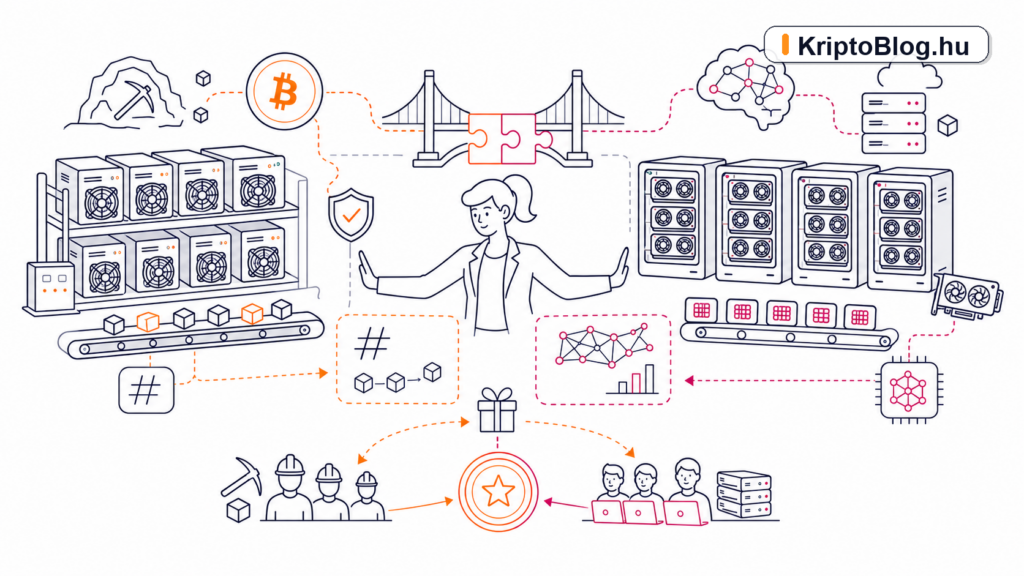
In Short
Bitcoin’s hashrate is an extraordinary global coordination achievement. But claims such as “600,000 times stronger than top supercomputers” need careful reading. SHA-256 mining power is not the same as GPU/TPU compute used for AI training.
The real lesson is not that Bitcoin ASICs will train AI. It is that Bitcoin showed how protocol-level incentives can coordinate global machine resources.
Hashrate And AI Compute Are Different
Bitcoin mining ASICs are optimized for one task: hashing. They are extremely efficient at it, but they are not general-purpose AI hardware.
AI training requires floating-point operations, memory bandwidth, GPU clusters, fast networking and data movement. The two can be compared dramatically, but they do not measure the same thing technically.
Why The Parallel Still Matters
The incentive model matters. Bitcoin does not organize computation through a central company. It rewards participants at protocol level. That logic inspires decentralized AI and compute markets.
If those markets work, it will not be because mining ASICs are repurposed. It will be because quality machine resources, verifiable output and economic incentives can be connected.
KriptoBlog.hu View
The hashrate comparison is a good attention hook, but it can mislead if taken literally. Bitcoin is not an AI supercomputer. It is proof that an open network can coordinate an enormous amount of specialized machine work.
The better question is not whether Bitcoin defeats AI monopolies, but whether decentralized compute protocols can create real demand and measurable quality.
Sources
- Binance Square: hash rate comparison
- PANews: Bittensor co-founder claim
- Cambridge Bitcoin Electricity Consumption Index
- Bittensor
Not financial advice.







Comments
Share your view: questions, corrections, and counterpoints are welcome. Comments are for constructive, useful discussion.