 blog
blog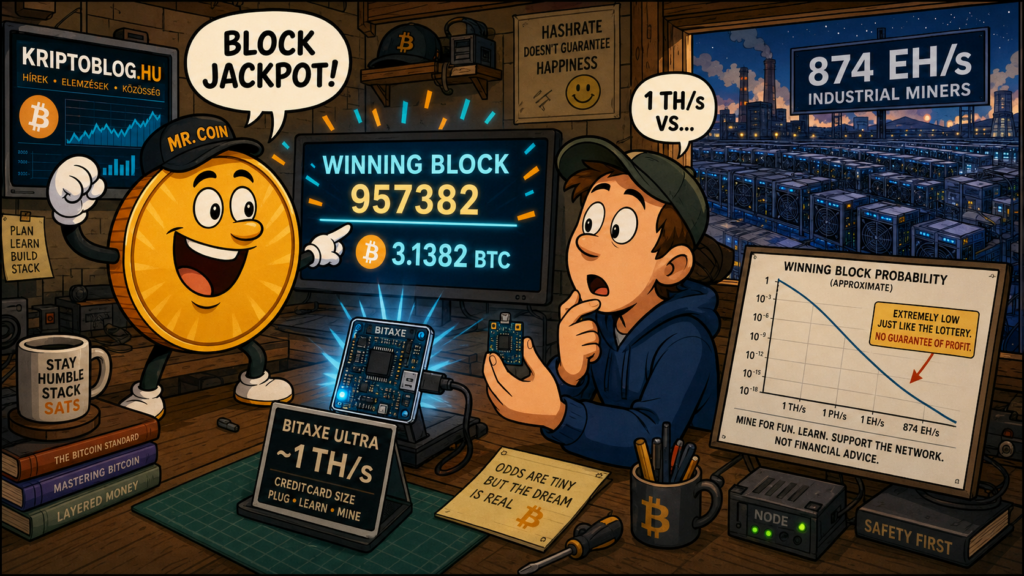
Sometimes the market presents a story worth pausing for. On July 9, in the early hours of Hungarian time, a solo miner — meaning someone who did not join a classic, multi-player mining pool to split profits proportionally — found the 957,382nd Bitcoin block using a single credit-card-sized Bitaxe device. They kept the full 3.1382 BTC reward, worth approximately $200,000. According to reports from CoinDesk and Cointelegraph, the acquisition cost of the device was around $150.
This type of news is easily read as if Bitcoin mining is returning to the romanticism of the early 2010s where "you could do it with a laptop." It is not returning. However, the fact that this could happen in 2026 reveals a very real, sympathetic face of the network — while also hiding sober lessons.
Exactly what happened in block 957,382
According to details from news.bitcoin.com, the device operated through a service called Public Pool and ran for only eight hours before submitting the winning share. Public Pool here did not function as a classic, reward-sharing mining pool: the service coordinated the distribution of block candidates and the submission, but the full reward of the found block went to the single winning address. The average hashrate was around 995.2 GH/s, approaching the device's factory value of 1 TH/s. The block reward consisted of the 3.125 BTC base subsidy and approximately 0.0132 BTC in transaction fees. The 3.125 BTC subsidy has been in effect since the 2024 halving; the protocol halves this amount approximately every 210,000 blocks, so over time the weight of transaction fees increases.
CoinDesk compares the event to a lottery win: the probability is illustrated as an average waiting time of approximately 18,000 years at this hashrate. The later cited range of 16,000 to 18,300 years measures the same event: the discrepancy arises from different assumptions regarding the instantaneous network hashrate and the device's actual performance. The calculation by news.bitcoin.com places the matter in an even stricter framework: at the moment of the block, the total Bitcoin network hashrate was approximately 874 EH/s, meaning a 1 TH/s device represented approximately 1/874,000,000 of the network's hashrate.
An interesting technical detail is that the winning share difficulty was 294.14 trillion — well above the network target — and since only one worker operated at that address, the full amount went to the miner without any pool fee deduction.
What is Bitaxe, and why is it so cheap?
For some readers, the protagonist may be new, so it is worth pausing for a moment. According to descriptions from CoinDesk and Cointelegraph, Bitaxe is an open-source, hobby-miner ASIC (application-specific integrated circuit — a chip designed specifically for one task, here SHA-256 hashing) based device that consumes 15–21 watts and is capable of 1–1.3 TH/s performance.
CoinDesk highlights that it uses the Bitmain BM1370 chip, which is also used in industrial Antminer S21 Pro machines — only as a single copy, mounted on a small panel. Its price, according to reports, ranges between $60 and $150. This is why Bitaxe today is more of a visual-educational tool than an economic one: a hardware device with which one can understand how proof-of-work works — and with which, as seen now, one can theoretically win.
Not an isolated case — a quiet trend
Cointelegraph, referencing mempool.space block data, reminds us that in April of this year, a hobby miner also found a block via the CKPool solo-service, and in February another retail miner solved a block using rented hashrate — in the latter case, therefore, it was not their own hardware working, but only the risk they carried.
Citing data shared by Public Pool, CoinDesk writes that in the past 12 months, solo miners found a total of 24 blocks, which is a 41 percent increase compared to the previous year. According to Cointelegraph's summary, the magnitude of rewards flowing in this way was 75.4 BTC, approximately $4.7 million in one year.
If we want to be honest, this number says two things at once. On one hand: statistically, solo mining remains a very, very rare event sequence. On the other hand: the phenomenon is not disappearing, but growing. Behind the growth is not an improvement in hit probability, but the fact that the open-source hardware community is making this experiment accessible to more and more people.
Why this matters even if you don't plan to buy a Bitaxe
Here comes the part where the story goes beyond the anecdote. Solo mining is statistically an insignificant factor in the network's security — a few TH/s of noise next to the approx. 874 EH/s total hashrate cited by news.bitcoin.com. But symbolically and from a decentralization perspective, it is not.
One of Bitcoin's core tenets is that the network is not the exclusive playground of a few giant miners. The reality is more nuanced: the vast majority of industrial capacity is concentrated in the hands of a few large players and pools. When a $150 device — even with lottery-like probability — finds a valid block, it reminds the market that this possibility exists at the protocol level. Nothing more, and nothing less.
It is important to accept the symbolic weight of such events precisely — not more. Bitcoin's decentralization is not saved by a single lucky Bitaxe, but it is also not indifferent that the network allows it at all.
FOMO, "this time it will be me," and cold mathematics
If you pause for a moment, you likely feel it yourself: when reading such news, for a second the thought arises, "what if...". This is a natural reaction, and not a problem in itself — but it becomes a problem if you make a decision based on it.
The magnitude cited by news.bitcoin.com is sobering: a 1 TH/s device would on average need to run continuously for between 16,000 and 18,300 years to find a block. This is not an investment calculation; it is a lottery ticket, only with electricity and hardware costs. Whoever buys the Bitaxe as a learning device, hobby, or community experience is in the right place. Whoever buys it as expected return will, according to the most likely outcome, pay their electricity bill — with minor or major inconvenience. This is not financial advice; this is the reading of the mathematics.
It is worth observing ourselves: when the market provides a "dreamscape" story, our brains tend to forget the denominator. Behind the 24 winning blocks is an unknown number of devices running quietly and mostly never winning. No CoinDesk article is written about any of them.
What to take away from this
We read this news more as a cultural signal than an investment signal. It shows that in 2026 there is still a living, experimenting hobby-miner community whose devices are affordable, open-source, and — rarely, but — capable of winning. This does not rewrite the network's economic picture, but it does change the face of the story.
Looking ahead, two things are worth watching. One is whether the rate of solo blocks continues to grow — if so, it is likely not about a change in luck, but about more hobby hashrate connecting in. The other is what long-term impact the open-source hardware direction (such as Bitaxe) will have on how we think about mining accessibility. There is no precise answer to these questions now — and precisely for that reason, it is worth following them.
If you read something like this next time, try to consciously separate enthusiasm from decision. Enthusiasm has its place — the Bitcoin story is partly about this. The decision, however, should be made coldly, with your own responsibility and your own mathematics; and we do not decide for you.
Sources
- CoinDesk: Solo BTC miner makes $200,000 using $150 equipment — coindesk.com (2026-07-14)
- Cointelegraph: Solo Bitcoin Miner Bags $200k Solo Block with Budget Bitaxe Rig — cointelegraph.com (2026-07-14)
- news.bitcoin.com: Bitcoin’s Lottery Jackpot: Solo Home Miner Wins $200,000 With a $150 Mining Device — news.bitcoin.com (2026-07-14)
- Bitcoin Optech: Pooled mining — bitcoinops.org (2026-07-14)




Comments
Share your view: questions, corrections, and counterpoints are welcome. Comments are for constructive, useful discussion.