 blog
blog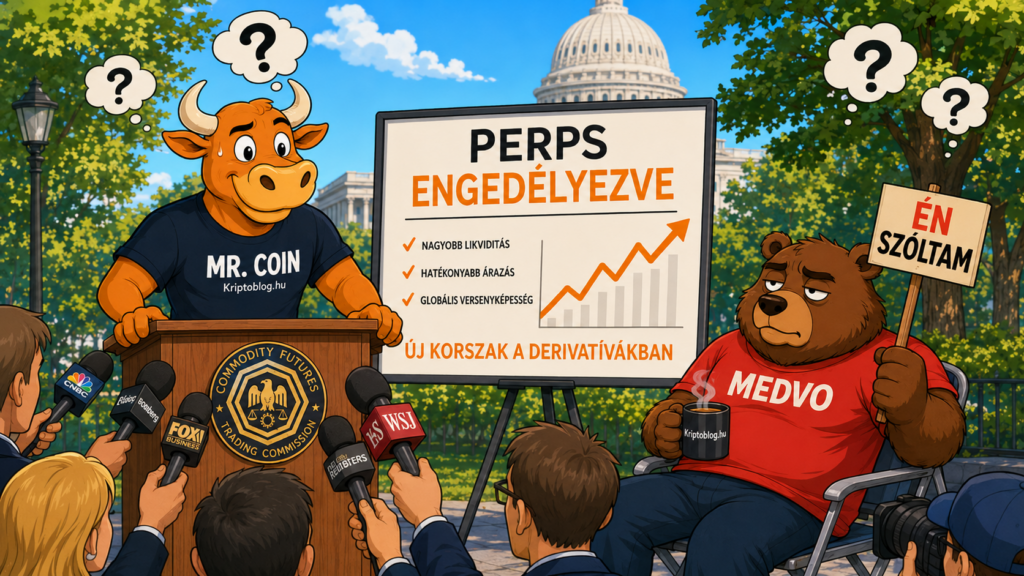
A magyar olvasónak könnyű elsiklani egy CNBC-szereplés fölött, de a június 15-i Fast Money adásban valami szokatlan történt. A CFTC elnöke, Michael Selig nem bejelentett egy döntést, nem ünnepelte, hanem megvédte azt. Pontosan ez az igeválasztás — a ‘defends’ — az, amelyen érdemes elidőzni, mert ez árulja el a leginkább, hogy mi zajlik az amerikai kripto-szabályozás színfalai mögött.
It would be easy to scroll past another CNBC appearance, but something unusual happened on the June 15 *Fast Money* segment. CFTC Chair Michael Selig didn't announce a decision, didn't celebrate one — he **defended** one. That verb choice — 'defends' — is worth lingering on, because it tells us more about what's happening behind the scenes of US crypto regulation than any press release would.
Perpetual futures (perps) — non-expiring derivative contracts that let traders take leveraged positions well beyond spot exposure — have until now been firmly off-limits under US regulators. Now they're not only authorized, but the agency's own chair is being forced to explain the authorization on live television. Meanwhile, the market is conspicuously calm: Bitcoin sits near $66,363, up roughly 1.0% on the day, while total crypto market capitalization has expanded to $2.35 trillion and BTC dominance holds at 56.5%. Quiet numbers under a loud political conversation.
Selig on CNBC: Who Was He Actually Talking To?
According to CNBC's coverage and Crypto Briefing's summary, Selig wasn't speaking in generalities about the elegance of derivatives — he was defending a specific decision. Point by point, he argued that a regulated onshore market is safer for the US investor than the current environment of offshore exchanges.
Anyone tracking the CFTC's messaging will notice the shift. Back on March 3 — also per Crypto Briefing — Selig confidently announced that a US perps market could launch within a month. That was announcement, not defense. By June, the tone had changed. In my experience this is rarely accidental: when a regulatory agency's chair has to argue in a live business broadcast for his own previously-stated decision, it signals institutional headwinds. The only question is where they're blowing from.
The $2.35 Trillion Question: Will Liquidity Come Home?
This is where the story gets genuinely interesting. Perps are by far the largest slice of global crypto derivative volume — market-data trackers consistently show them exceeding spot daily volume — and most of that pie has so far been served by Binance, Bybit, and a handful of smaller offshore exchanges. American traders accessed these venues through VPNs and offshore entities, while officially they were served by Kraken Futures or CME's mini contracts — in stripped-down, capital-intensive form.
És itt jön a saját, óvatos értékelésem. A piac nem azért ment offshore-ra, mert nem szerette Amerikát. Hanem mert offshore kisebbek a margekövetelmények, lazább a KYC, és a likvidálási mechanizmusok kereskedő-barátabbak. Ha az amerikai onshore perps-piac magasabb tőkekövetelménnyel és szigorúbb felügyelettel indul — márpedig a CFTC nem viccből nevezik szigorú felügyeletnek —, könnyen előállhat, hogy a profi kereskedők egy része továbbra is offshore marad, és csak az intézményi pénz, valamint a kisbefektetők kerülnek be a hazai keretbe. Ez nem feltétlenül baj; az viszont reális, hogy a ‘hazatérés’ lassabb és részlegesebb lesz, mint a politikailag csengő narratíva sugallja. A mi megközelítésünk: a derivatívák nem helyettesítik a türelmes szpot-építkezést — ha bele is mész, fogd vissza az áttétet, és sose tedd kockára azt, amit nem engedhetsz meg magadnak elveszíteni.
A ‘lone chair’ probléma: egy ember a derivatív piac fölött
A Blockonomi június 12-i elemzése egy kényelmetlen kérdést tett fel: Selig jelenleg az egyetlen megerősített biztos a CFTC élén. A ‘lone chair’ státusz azt jelenti, hogy a normál esetben több biztosból álló testület döntései egyetlen ember kezében koncentrálódnak — különösen a kripto és a prediction market (előrejelzési piacok) területén, ahol Selig nyíltan vállalt napirenddel érkezett.
A Blockonomi analysis from June 12 raised an uncomfortable question: Selig is currently the only confirmed commissioner at the head of the CFTC. The 'lone chair' status means that decisions normally made by a multi-commissioner panel are concentrated in a single pair of hands — particularly in crypto and prediction markets, where Selig has arrived with an openly stated agenda.
This isn't a political question in the classical sense, and I'll stick to my line of not focusing on partisan politics here. It's institutional: can one person decide the future of the entire US derivative crypto market? Technically yes — the CFTC's operating rules permit it — but from market participants' perspective, that concentration creates risk. A decision made by one person can be reversed by one person. The perps approval may be legally solid; institutionally, it's only as solid as Selig's position. And it's hardly accidental that he has to keep defending it.
CFTC and SEC: The End of Parallel Regulation?
The CFTC's official communications (cftc.gov) also indicate that the agency is working in close coordination with the SEC on a shared regulatory framework, explicitly aimed at reducing duplicated oversight. This matters: the most exasperating problem in US crypto regulation has been that a given token or service sometimes fell under the CFTC, sometimes the SEC, sometimes both — or neither, which is the worst combination of all.
If that coordination works, it could be a breakthrough for Coinbase, Kraken, and every domestic (read: US) exchange: finally clear ground rules about what they can offer. If, however, the coordination collapses alongside any weakening of Selig's position, the industry returns to its prior unpredictable state. From experience: the crypto market has never loved regulation as much as it loves predictability. The two are not the same.
Mit üzennek együtt ezek a hírek? Először is azt, hogy a hivatalos amerikai álláspont a kripto-derivatívákról jelentősen elmozdult — és ez objektíven kedvező a globális piacnak. Másodszor azt, hogy ez az elmozdulás törékeny: ha a CFTC elnökének élő tévében kell védenie a döntését, akkor a döntés nincs biztonságban. Harmadszor pedig azt, hogy a piac pszichológiája éppen most rendkívül árulkodó. A Bitcoin egy százalékos napi mozgása egy ilyen szabályozási hír mellett azt mutatja: a befektetők megtanultak nem hibázni a ‘regulation FUD’ felé. Sem pánikot, sem eufóriát nem látunk. Ez érettség — vagy fáradtság, attól függ, honnan nézed.
Az ‘ezúttal más lesz’ érzés, amely a 2017-es és 2021-es ciklusokban annyi sebet hagyott, most furcsamód halkabban szól. Talán mert tényleg más — szabályozott derivatívák, ETF-ek, intézményi részvétel —, talán mert a piac kifáradt a saját narratíváiban. A kettő közötti különbséget nem lehet előre megmondani; csak utólag, és csak fáj.
The 'this time it's different' feeling that left so many scars in the 2017 and 2021 cycles is, oddly, quieter this time. Maybe because it really is different — regulated derivatives, ETFs, institutional participation — and maybe because the market has worn itself out on its own narratives. You can't tell the difference in advance; only in hindsight, and only painfully.
A következő hetek figyelendő pontjai: indul-e ténylegesen az amerikai onshore perps-piac, és milyen tőkekövetelményekkel; meddig marad Selig egyedüli elnök; és hogyan reagál a Coinbase, illetve a Kraken — mindkét tőzsde régóta dolgozik saját perpetual termékeken. Ha az indulás konkrét forgalmi adatokkal és átlátható kockázatkezeléssel érkezik, az amerikai piacnak valódi esélye lehet a globális likviditás egy részének visszahozatalára. Ha viszont az ellenszél felerősödik, akkor a ‘hazatérés’ inkább szándéknyilatkozat marad, mint mérhető pénzmozgás.
Things to watch over the coming weeks: whether the US onshore perps market actually launches, and at what capital requirements; how long Selig remains the sole chair; and how Coinbase and Kraken respond — both exchanges have been working on their own perpetual products for years. If the launch arrives with concrete volume data and transparent risk management, the US market has a real shot at clawing back some of the global liquidity. If, however, the headwinds intensify, 'coming home' will remain more a statement of intent than measurable capital flow.
Sources
- CNBC Fast Money — CFTC chair Selig defends decision to approve ‘perps’ in U.S. (2026-06-15) — forrás
- Crypto Briefing — CFTC Chair Michael Selig defends approval of perps trading in US (2026-06-15)
- Crypto Briefing — CFTC chair Michael Selig targets US launch of crypto perpetual futures within a month (2026-03-03)
- Blockonomi — CFTC’s Lone Chair Selig Expands Grip Over Crypto and Prediction Markets (2026-06-12)
- Commodity Futures Trading Commission hivatalos oldala (megnyitva 2026-06-16) — forrás
- CoinGecko piaci adatok (2026-06-16)





Comments
Share your view: questions, corrections, and counterpoints are welcome. Comments are for constructive, useful discussion.