 blog
blog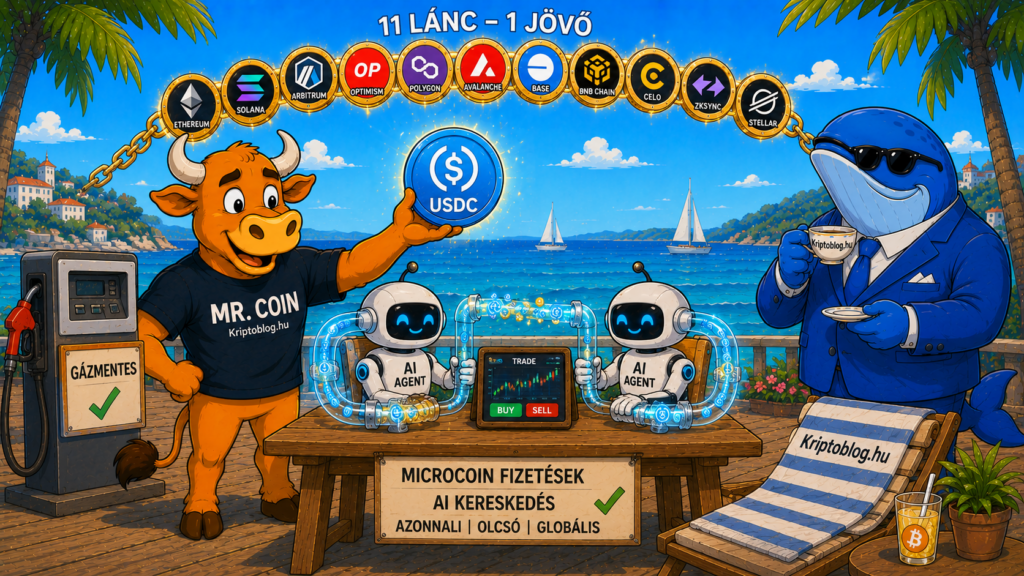
A kriptovaluta-piac egyik legfontosabb technológiai áttörése éppen akkor következett be, amikor a mesterséges intelligencia (AI) ügynökök az autonóm döntéshozatal és a gazdasági tevékenység határán állnak. A Circle, a globális USDC stablecoin kiadója, bejelentette a Nanopayments funkció megindulását a főhálózaton (mainnet), amely 11 különböző blokkláncon teszi lehetővé a gázmentes, mikroszkopikus értékű tranzakciókat. Ez a fejlesztés nem csupán egy kényelmi funkció, hanem a gép-gép közötti (Machine-to-Machine, M2M) gazdaság rejtett motorjának az első valódi türelmes építőköve.
As of April 30, 2026, the total crypto market capitalization has reached $2.63 trillion according to CoinGecko data. Currently, the market is driven primarily by human users and high-value institutional movements, with Bitcoin dominance standing at 58.2%. The landscape is dominated by Bitcoin ($1.53 trillion) and Ethereum ($272.63 billion). Within this environment, Circle’s latest move targets a completely new market segment: AI-driven microtransactions, where even a fraction of a cent carries significant weight.
A New Chapter: Nanopayments Across 11 Blockchains
According to Circle's latest announcement, the Nanopayments feature is now live on the mainnet, specifically engineered to ensure that interoperability is never a barrier. The rollout spans 11 different blockchains simultaneously—a feat requiring extraordinary technical coordination. The goal is to ensure that USDC, the leading stable digital payment tool, is suitable not just for large transfers, but for the smallest microscopic transactions without network gas fees consuming the value.
Based on official Circle communications, this solution allows transactions to be gasless for the user (or the autonomous agent). This technology fundamentally alters the onboarding process: previously, executing a $0.01 transaction on the Ethereum network was economically impossible due to gas costs. Circle’s solution effectively erases the friction between blockchain technology and real-world micro-utility.
Behind the technical implementation lie complex protocols that allow for the pre-planned, fee-free handling of transactions across various networks. This widespread support ensures that developers can build solutions within a global, fragmented blockchain ecosystem rather than being locked into a single silo.
Why AI Agents are the Most Critical New Users
While most crypto projects focus on Business-to-Consumer (B2C) or Business-to-Business (B2B) models, Circle Nanopayments targets a entirely new category: the Machine-to-Machine (M2M) economy. In this system, transactions are executed not by humans, but by autonomous AI agents.
Consider this scenario: an AI agent managing a smart home system, or an algorithm purchasing data on the web, must constantly pay tiny amounts to various service providers. As noted in analyses by CoinDesk, the growth of the AI sector creates micro-service demands where payments must occur in milliseconds and at minimal cost. If an AI agent needs to pay just $0.001 USDC for a single data sheet or a unit of compute power, traditional blockchain gas fees (which can often exceed several dollars) render the process completely unusable.
Nanopayments effectively turns AI into a true economic actor. AI agents do not wait for bank transfers, nor do they want to manage the complexity of calculating gas fees; they require a payment layer that is invisible yet continuous. This technology is the missing link between artificial intelligence and blockchain, enabling truly autonomous economic agency.
Technical Advantages of Gasless Transactions and the Role of USDC
Gaslessness is not merely a marketing term; it is a technical necessity in a microscopic economy. Circle achieves this by utilizing a layer that pre-pays or subsumes network costs, ensuring the final transacting party only sees the net USDC amount on their balance.
USDC plays a pivotal role here. Because the stablecoin is pegged to the US Dollar, price stability is essential for AI agents. An AI cannot risk a transaction where the value fluctuates by 20% due to volatility. Circle’s success lies in positioning USDC as "programmable money" capable of handling the complex logic of the smallest value flows.
One might ask: does gaslessness jeopardize network security via spam transactions? A cornerstone of blockchain security is the cost of transactions, which prevents actors from flooding the network with irrelevant data. Circle’s solution likely incorporates limiting mechanisms and authentication processes to ensure that Nanopayments only permit legitimate transactions functioning within the AI economy, thereby protecting the underlying networks.
The Future of the Machine Economy: Microscopic Value, Maximum Efficiency
The concept of the Machine Economy relies on efficiency found in speed and granularity rather than sheer volume. Just as the internet enabled the distribution of information, gasless Nanopayments will enable the atomized distribution of value.
In the future, it won't just be humans purchasing products; devices will trade with one another. An electric vehicle will pay a charging station based on per-minute data; a sensor will pay an analytics platform for its data; and an AI model will pay a training-data provider. These transactions will be so small that traditional banking systems or gas-heavy blockchains could never process them. With this development, Circle is building the infrastructure to turn even a fraction of a cent into economic value.
Key Takeaways for Investors
For the average reader, this development is a signal of a long-term macro trend. While we may not be using nanopayments in our personal wallets immediately, it opens new horizons for investors and developers.
Tanács az olvasóknak:
- Figyeljen az AI-kripto konvergenciára: A következő bull market egyik legfontosabb narratívája az AI és a blokklánc találkozása lesz. A Circle ilyen lépései jelzik, hogy a valódi hasznosítás a szolgáltatások automatizálásában rejlik.
- A stablecoinok evolúcióját figyelje meg: A stablecoinok már nem csak digitális dollárok, hanem aktív, programozható eszközökké válnak. A USDC ilyen integrációja növelheti a projekt hosszú távú relevanciáját.
- Ne csak a nagy tranzakciókra koncentráljon: A piaci kapitalizáció növekedése (jelenleg 2,63 billió USD) mellett a tranzakciós volumen és a tranzakciók minősége (mennyiség vs. érték) fogja meghatározni a következő ciklus győzteseit.
In summary, Circle Nanopayments is not just a technical update; it is a paradigm shift in blockchain-based payment systems. The road toward a Machine-to-Machine economy has begun, and gasless microtransactions will be the force that enables the true economic power of artificial intelligence.
Sources
- Circle Official Announcement: „Circle Launches Gas-Free ‘Nanopayments’ on Mainnet Across 11 Blockchains” (2026. 04. 30.)
- CoinGecko Piaci Adatok: Bitcoin, Ethereum és globális market cap adatok (2026. 04. 30.)
- CoinDesk: AI and Machine Economy Analysis (2026. 04. 30.)






Comments
Share your view: questions, corrections, and counterpoints are welcome. Comments are for constructive, useful discussion.