 blog
blog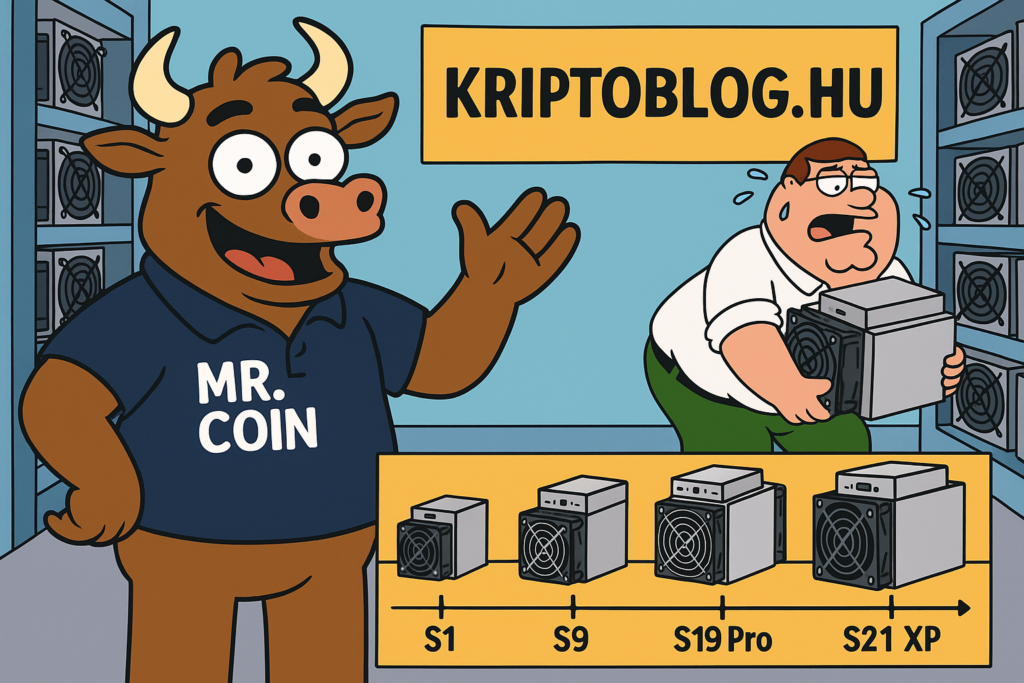
The History of Bitmain: From the S1 to the S23
If someone says "Bitcoin mining" to me, the first thing that comes to mind is Bitmain. Not by accident — this company practically single-handedly rewrote the rules of how new Bitcoin is created. But let's start from the beginning, because the story didn't start with Bitmain at all.
The Beginnings: From CPU to ASIC
I remember when I first read about Bitcoin mining around 2013. Back then, many people still tried mining with a CPU — yes, with a regular desktop computer's processor. Then came the GPUs (graphics cards), which could hash orders of magnitude more efficiently. Then appeared the FPGAs (Field-Programmable Gate Array), which were already programmed specifically for this purpose.
But the real revolution came in 2013, when the first ASIC (Application-Specific Integrated Circuit) miners appeared. These chips were designed exclusively for one thing: computing SHA-256 hashes. Nothing else. But they do that brutally well.
The Birth of Bitmain (2013)
Two Chinese entrepreneurs, Jihan Wu and Micree Zhan founded Bitmain in 2013 in Beijing. Jihan Wu was the one who first translated Satoshi Nakamoto's Bitcoin whitepaper into Chinese — so he wasn't a newcomer to the topic. Micree Zhan was the genius of chip design.
Their first model, the Antminer S1, arrived with 180 GH/s performance, on 55nm chips. By today's standards, this is a joke — a modern top machine can do millions of times more. But back then? Back then this was rocket science .
The S1-S9 Era: The Foundation
Bitmain's development was impressive:
- S1 (2013) — 180 GH/s, 55nm chip, ~2000 J/TH efficiency
- S5 (2014) — switched to 28nm chip, significant efficiency improvement
- S7 (2015) — further refined design
- S9 (2016) — 13.5 TH/s, 16nm chip, 100 J/TH
Now, let's stop at the S9for a moment, because this machine is legendary. I'm serious, the S9 is the AK-47 of Bitcoin mining: simple, reliable, virtually indestructible. I remember when I bought my first S9 in 2017 — the packaging hadn't even dried before it was running in the living room, buzzing like a small airplane. My wife wasn't thrilled, but the daily revenue at BTC prices back then? That was thrilling.
The S9 for years remained the market's best-selling miner. Even in 2020, tons of S9s were still working around the world. Many still use them today in regions with cheap electricity. This machine was what truly democratized Bitcoin mining — relatively speaking, of course, since you still had to put down a few thousand dollars for it.
The New Generation: S17, S19, S21
Bitmain didn't stop at the S9, even though many said you couldn't make something much better. They were wrong.
| Model | Year | Hashrate | Chip | Efficiency (J/TH) |
|---|---|---|---|---|
| S17 | 2019 | 53 TH/s | 7nm | 40 |
| S19 | 2020 | 95 TH/s | 7nm | 34.5 |
| S19 Pro | 2020 | 110 TH/s | 7nm | 29.5 |
| S19 XP | 2022 | 140 TH/s | 5nm | 21.5 |
| S21 | 2024 | 200 TH/s | 5nm | 17.5 |
| S21 Pro | 2024 | 234 TH/s | 5nm | 15 |
| S21 XP | 2025 | 270 TH/s | 5nm | 13.5 |
| S21 XP Immersion | 2025 | 300 TH/s | 5nm | 13 |
The S19 series was what made Bitmain truly competitive with 7nm chips. The S19 Pro was the best value miner on the market for a long time. In my personal experience, the S19 family is also excellent in terms of reliability — mine ran for three years without a break.
The S21 series brought the next big leap in 2024. The 200 TH/s base model produces nearly 15 times the hashrate compared to the S9, while being 5.7 times more energy efficient. This is astonishing progress within a single decade.
The Future: S23 and Beyond
In 2026, the news is already about the S23e model: ~330 TH/s hashrate, ~10.6 J/TH efficiency. This means we're slowly approaching the limits set by physics — but I'll write about that in detail in another article.
I believe the secret to Bitmain's success was that they were always one step ahead of the competition in chip design. Their partnership with TSMC (Taiwan Semiconductor) was crucial — they always used the most cutting-edge available manufacturing technology.
The Dark Side
Of course, not everything is sunshine and rainbows. Bitmain has faced a lot of criticism over the years:
- A BCH fork support in 2017 divided the community
- The Antbleed scandal (built-in backdoor in the firmware)
- Power struggle between Jihan Wu and Micree Zhan for control of the company
- A monopolistic market position, which many believe threatens Bitcoin's decentralization
So, what do you think? Is Bitmain a blessing or a curse for the Bitcoin ecosystem? I say: both. They accelerated technological progress, but in the process created a dangerous level of centralization. This dilemma won't go away anytime soon.
Sources
- ASIC Miner Value — Miner comparison database
- D-Central Tech — Bitmain Antminer evolution
- Compass Mining — Mining industry news
- BT-Miners — ASIC miner specifications
⚠️ Legal disclaimer: This article is for informational purposes only and does not constitute financial or investment advice. Cryptocurrency mining involves significant risks. Before any investment decision, do your own research (DYOR) and consult a financial expert if needed. The data in this article is valid at the time of publication and may change at any time.



Comments
Share your view: questions, corrections, and counterpoints are welcome. Comments are for constructive, useful discussion.