 blog
blog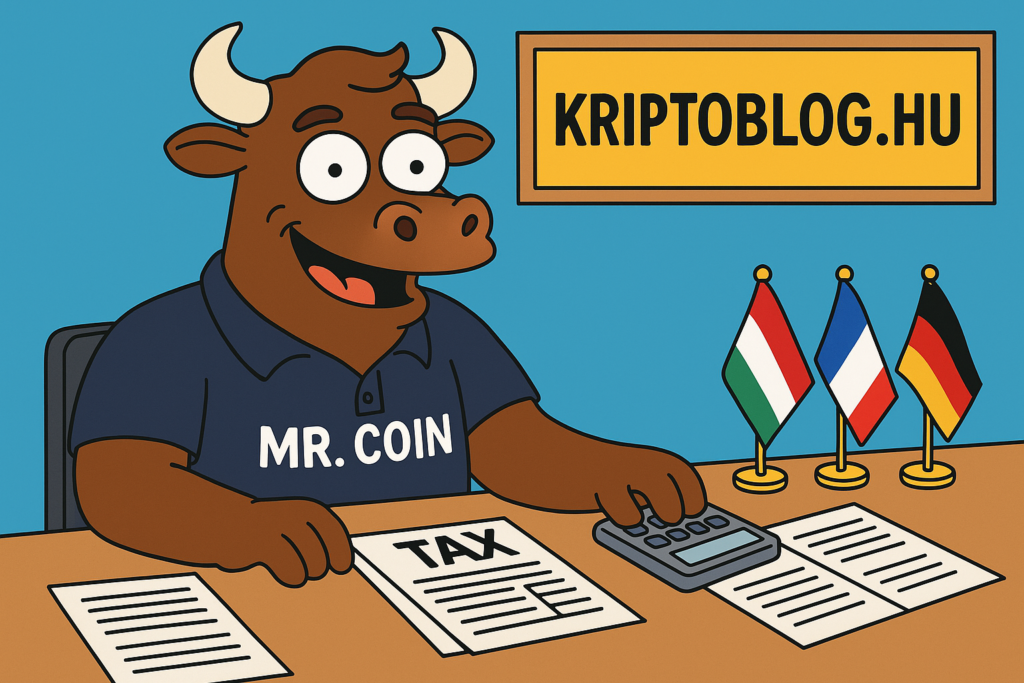
Crypto taxation: the European jungle
Cryptocurrency taxation in Europe is a veritable regulatory mosaic. There is no unified EU-level tax policy – each country determines how to tax crypto assets. This means both opportunities and headaches at the same time. Let's look at how things stand in 2026!
Country comparison
🇩🇪 Germany – The HODLer's paradise
Germany offers one of the most favorable tax environments:
- Tax-free after 1 year of holding: If you hold your crypto for more than 12 months, the profit is entirely tax-free.
- €600 exemption: Profits below €600 annually are tax-free, regardless of holding period.
- Staking yield: Staking and lending yields are exempt after a 10-year holding period (disputed).
German regulation is therefore particularly favorable for those who hold their crypto assets long-term. However, it's worth noting that taxation of staking rewards and lending yields is still a subject of debate.
🇵🇹 Portugal – The former tax paradise
Portugal was completely tax-free for crypto gains until 2023. Since then, the following rules apply:
- 28% capital gains tax for holding periods shorter than 1 year.
- Holding over 1 year: Still tax-free.
- Still one of the most favorable in Europe, but the "paradise" status has ended.
Portugal can therefore still be an attractive destination for long-term investors, but short-term traders now have to account for tax burdens. I think it's still worth considering if you're contemplating relocation.
🇨🇭 Switzerland – Investor-friendly approach
- Individuals: Cryptocurrency capital gains are tax-free if they qualify as "private wealth management."
- Wealth tax: The value of crypto assets is included in the annual wealth tax.
- Mining and staking: Taxed as income.
- Cantonal differences: The canton of Zug ("Crypto Valley") is particularly favorable.
Switzerland therefore remains an attractive location for crypto investors, especially the canton of Zug, which offers special conditions for crypto businesses.
🇫🇷 France – The flat tax key
- Flat tax: 30% (12.8% income tax + 17.2% social contributions).
- €305 exemption: Profits below €305 annually are tax-free.
- Crypto-to-crypto swaps are tax-free (only taxed when converting to fiat).
In France, the flat tax rate means simplification, but due to the high tax burden, it's not necessarily the most favorable country for crypto investors.
🇮🇹 Italy – On the path of tax increases
- 26% capital gains tax on profits exceeding €2,000.
- Raised to 42% in 2025 (disputed, enforcement uncertain).
- There was an amnesty program for previously undeclared gains.
In Italy, high tax rates and uncertainty can make life difficult for investors. The amnesty program, however, may provide an opportunity to correct past mistakes.
🇭🇺 Hungary – The complex tax structure
The Hungarian rules are as follows:
- 15% PIT on cryptocurrency profits.
- 13% Social Contribution Tax (social contribution tax) – but there is an upper limit.
- In total, up to ~28% tax burden.
- Tax base: Selling price – acquisition price = profit.
- Crypto-to-crypto swaps are also taxable events.
- Mining is taxed as income.
In Hungary, crypto investors should thoroughly prepare for their tax returns, especially due to the complex tax structure.
DAC8: The EU Data Exchange Directive
In 2025, the DAC8 directive came into force, which requires crypto asset service providers to report client transactions to tax authorities. This applies EU-wide to:
- All exchanges and custodians operating in the EU.
- Automatic data exchange between member states.
- The goal: making tax evasion more difficult.
In practice, this means: the tax authority will knowhow much you traded. The era of voluntary reporting has been replaced by automatic data reporting, so it's worth keeping track of every transaction and reporting accurately.
DeFi and NFT Taxation: The Gray Zone
The greatest uncertainty surrounds DeFi transactions:
- Yield farming: At what point does the tax obligation arise? When the token is acquired? When it's sold?
- Liquidity providing: Is impermanent loss deductible?
- Airdrops: Taxed as income or only upon sale?
- NFTs: Taxed as artwork or as a crypto asset?
These questions still pose serious challenges for taxpayers. It's worth closely following current developments and consulting an expert when needed.
Why Does This Matter?
Taxation is important not only for compliance with laws but is also crucial from a financial planning perspective. The tax burden can significantly impact investment decisions, especially with crypto, where prices can change rapidly.
Ignoring taxation can not only cause financial losses but also have legal consequences. EU-level regulations like DAC8 make it easier for tax authorities to identify tax evaders.
Practical Tips
- Record-keeping: Keep accurate records of every transaction – date, amount, exchange rate.
- Tax software: Koinly, CoinTracker, Accointing – these automatically calculate the tax base.
- Tax advisor: For complex portfolios, it's worth finding an accountant experienced in crypto taxation.
- FIFO vs. LIFO: The method choice (First In First Out vs. Last In First Out) can significantly affect the tax base.
- Updates: Regularly check for changes in tax rules in your country.
How does this affect you?
If you deal with cryptocurrencies, it's worth being aware of your country's tax rules. Tax burdens and the regulatory environment can significantly affect the efficiency of your investments. It's important to look not only at short-term profits but also at long-term tax consequences.
It may be worth preparing now for future changes, such as automated data reporting, which is already inevitable in the EU. Think ahead and plan your transactions to minimize tax burdens.
In Conclusion
European crypto taxation is complex and changing. With DAC8, transparency is increasing, which is both good news (professionalization) and bad news (nowhere to hide). The best strategy: stay informed, keep records, and pay taxes. Crypto is no longer "invisible money." Taxation isn't a sexy topic, but those who ignore it will see their profits quickly
Sources
⚠️ Legal disclaimer: This article is for informational purposes only and does not constitute investment advice. All investment decisions are made at your own risk.






Comments
Share your view: questions, corrections, and counterpoints are welcome. Comments are for constructive, useful discussion.